- Soch Vichaar
- Posts
- Should Indians work for 70 hours per week?
Should Indians work for 70 hours per week?

Mohak Mangal
October 31st, 2023
What happened?
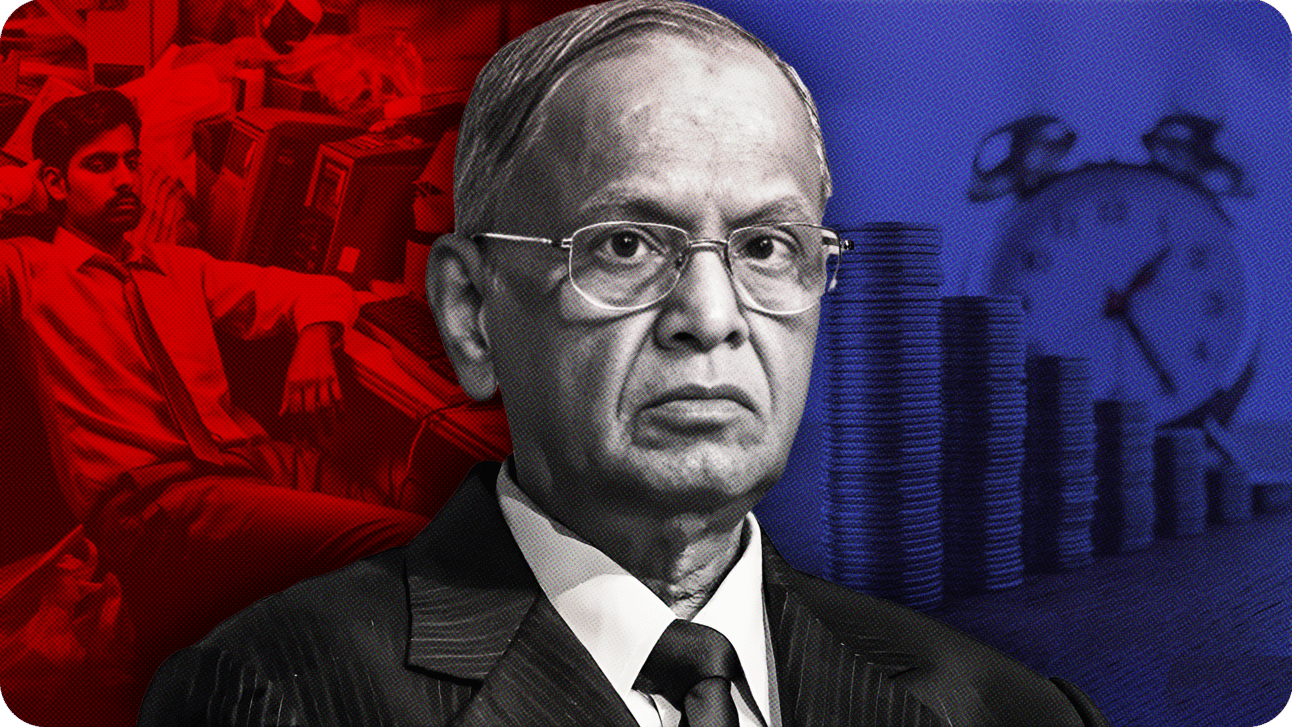
Infosys founder Narayana Murthy's suggestion that youngsters should work 70 hours a week for nation-building has sparked a debate. Murthy pointed out that India's work productivity is one of the lowest in the world. So, to compete with countries like China, India's youth must put in extra work hours – like Japan and Germany did after the Second World War.
Many on social media didn't agree with him. They raised concerns about low pay and a poor work-life balance.
However, many CEOs in India supported Murthy's view. They believe India's challenges are different because it is a developing country. People in advanced countries work only 4 or 5 days a week because their older generations have worked longer. So, they opposed adopting the shorter work weeks of developed nations as the norm for India.
Interestingly, even Elon Musk thinks that to "change the world," one might need to work around 80 to 100 hours a week!
What does research suggest?
Productivity: According to a study at Stanford University, people's productivity drops sharply after working more than 50 hours a week. Surprisingly, those working 70 hours produce the same output as those working 55 hours.
Increasing work hours does not guarantee increased productivity. The data indicates that average productivity in poorer countries tends to be much lower than in wealthier countries. For instance, India ranks fifth in the world for long working hours, even though it has one of the lowest minimum wages.
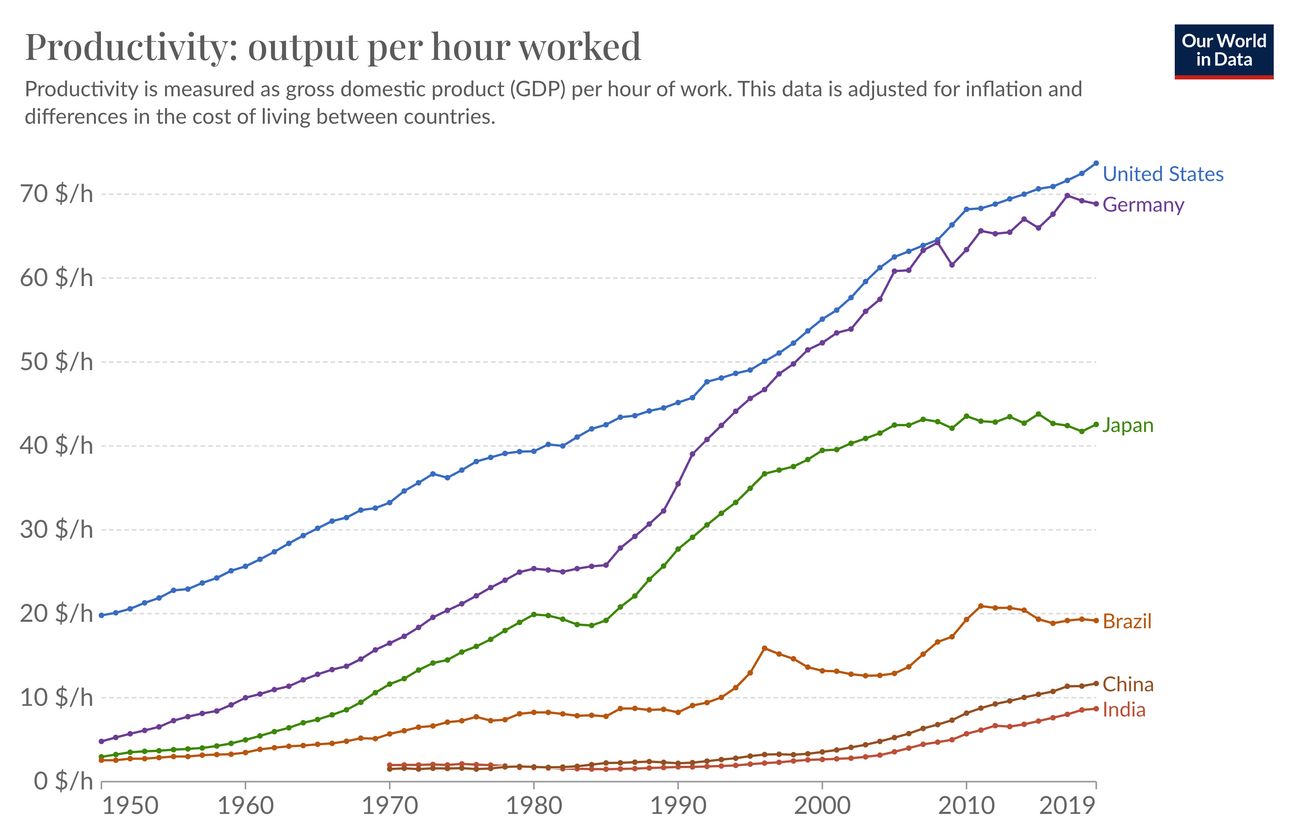
Source: Our World in data
Some advanced countries are considering shorter work weeks to enhance work-life balance and productivity. Like Microsoft Japan experimented with a 4-day work week in 2019 and observed a 40% increase in productivity!
Health risks: HR experts state that overworking can harm a person's health. Research from the WHO and the International Labour Organization shows a 42% increase in deaths from heart disease and a 19% increase in deaths from stroke for those working more than 55 hours.
Other studies reveal that stress from too much work can cause problems like diabetes, depression, sleep and memory issues. These result in additional costs for companies, such as more employees missing work and higher healthcare and insurance costs.Impact on women: Drawing from NSSO data, Indian women invest an average of 7.2 hours daily in household tasks. In stark contrast, men dedicate about 2.8 hours to similar chores. So, women get far less time than men for leisure. As per studies, extensive work hours on top of these domestic responsibilities can increase the risk of diabetes by 70% in women.
What's next?
As per the labour laws in India, it is not permissible to employ a worker for more than 48 hours in a week. In case an employee works more, they are entitled to overtime pay. Thus, longer working hours should remain a personal choice rather than a rule.
Bonus section
The power of starting imperfectly

When you have a goal, like beginning photography or eating better, it's common to try to copy their methods. But often this can be overwhelming. Instead, you could start “imperfectly.“
Here are a few examples:
Skill development: You don’t need the best camera to learn photography. On a tight budget? Even expert photographers once started with an entry-level camera.
Eating healthy: You might see fitness gurus recommending organic, vegan foods or exotic fruits. But you can start by making small changes. Just focus on eating more seasonal fruits and vegetables regardless of whether they are organic.
Similarly, you can begin exercising by doing bodyweight exercises at home. You don't need the advanced equipment that athletes have.
So, stop saying that you should "learn more" or "get everything in order first." Start imperfectly, as you can continually refine and improve things along the journey.
NOTEWORTHY 📑
How is China designing flood-resistant "sponge" cities?
Bangladesh is building a memorial to honor Indian heroes of 1971 war
Meet the woman who first introduced the Women’s Reservation Bill
Black holes and unlocking the mysteries of our universe
India abstains from UN General Assembly vote on Israel-Hamas war
SHARE THIS VICHAAR 🙌

If you enjoyed reading my newsletter, please consider sharing it with your loved ones.
Was this forwarded to you? Sign up here.
If you want to give us feedback, Click here.
Read our previous newsletters here
Reply