- Soch Vichaar
- Posts
- UP bans ‘halal’ products. Why?
UP bans ‘halal’ products. Why?

Mohak Mangal
November 21st, 2023
What happened?
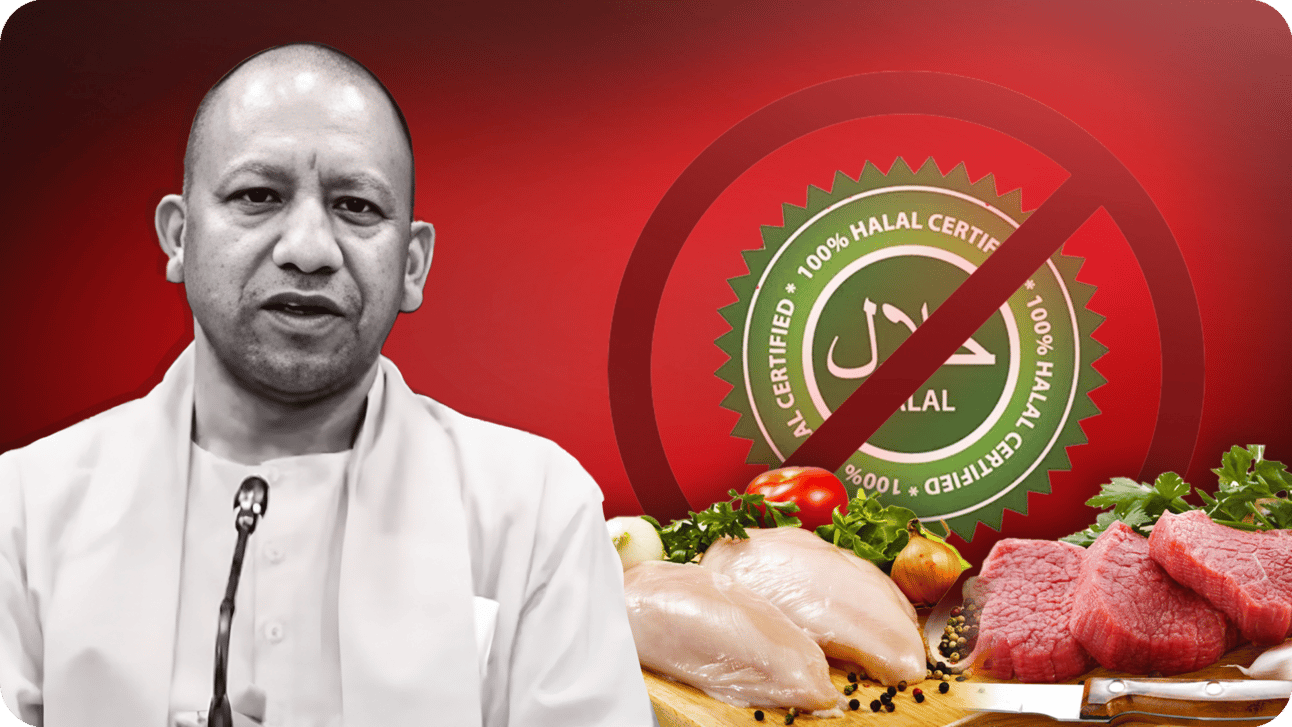
The Uttar Pradesh government has banned the production and sale of halal-certified food products. Halal products meet the requirements of Islamic law and are deemed suitable for consumption by Muslims.
State police also filed an FIR against organizations like Jamiat Ulama-i-Hind Halal Trust for allegedly issuing fake 'halal' certifications for edible and cosmetic products to boost sales. Thereby exploiting religious sentiments and betraying the trust of Muslims. The FIR reveals unauthorized halal certificates even for "vegetarian" items like beauty products, oil, soap, toothpaste, and honey.
Why does it matter?
The government does not mandate halal certification or have a unified law in India. Private companies issue halal certifications. The National Accreditation Board for Certification Bodies (NABCB) under the Quality Council of India accredits these halal certification companies.
Notably, halal differs from the 'jhatka' method favored by many Hindus and Sikhs. Jhatka involves a swift blow to the animal's neck before slaughtering, which is considered less cruel than the halal method.
What are the arguments from both sides?
Side 1: In support of the ban: The UP government asserts that halal certification creates confusion by creating a parallel authorization system, stating that the responsibility to determine food quality lies with authorized bodies under the Food Safety and Standards Act.
Finance Minister Nirmala Sitharaman emphasized that government agencies, not non-governmental organizations, should handle food certification to ensure public health.
The FIR also raised concerns about a widespread conspiracy to reduce the sales of products from companies without a halal certificate, which is deemed illegal. There's a worry that this unfair advantage could benefit anti-social and anti-national elements to sow communal disharmony.
In Karnataka, Hindutva groups are pushing for a ban on halal establishments, advocating for jhatka meat shops and supermarkets. Such groups claim that "animals are killed by offering them to Allah for halal process, and it would be offensive for Hindus to offer the meat to their gods." Additionally, halal-certified products adversely affect the businesses of non-Muslim communities.
Side 2: Against the ban: Muslim groups advocate for the exclusive use of halal-certified products, extending to various aspects of life like income, work, cosmetics, and medicines. For example, concerns about gelatin capsules made from pig fat drive the preference for halal alternatives.
The President of the Halal Council of India (HCI) refuted the claim that companies providing halal certificates aimed to favor only one community. Venky's, Zorabian, and Godrej (companies certified by HCI) are all run by non-Muslims.
Jamiat Halal Trust emphasized the impact of UP's halal-products ban on manufacturers and sellers across communities. The halal trade, valued at $3.5 trillion, significantly contributes to India's exports and tourism, particularly with crucial trade partners in the Organisation of Islamic Cooperation (OIC) countries and Southeast Asia. So, to safeguard economic interests, export items have been exempted from the ban.
What's next?
Strict legal action will be taken against any person or company engaged in halal-certified products within Uttar Pradesh, including medicines and cosmetics.
Jamiat Halal Trust dismissed the accusations against it as "baseless" and a bid to "tarnish" its image. The trust plans to initiate legal measures to counter the spread of misinformation.
Un-charted
Shrinking sleeper coaches, skyrocketing train fares

This chart reveals that the availability of budget-friendly sleeper class coaches has decreased, and the number of expensive air-conditioned coaches is going up, according to the South Eastern Railways.
Regarded as the lifeline for many Indians, train travel is becoming increasingly challenging. During festive seasons like Diwali to Chhath Puja, train ticket prices experience significant surges. Notably, the sleeper class fare on the Mumbai-Patna Suvidha Express (Premium Express) trains spiked from Rs 800 to Rs 2,625. At the same time, a second AC ticket soared above Rs 9,000! Despite the 26-hour journey, it competes in pricing with a 2.5-hour flight.
Here's why: These premium express trains launched in 2014 for busy routes introduced dynamic ticket pricing- As more people travel during festivals or vacations, ticket prices change based on demand, like how flight charges work.
Additionally, tickets for approximately 1.44 crore waitlisted passengers unable to get a berth were automatically cancelled. IRCTC stated that this contributed to Railways earning over ₹83.85 crore in cancellation charges.
Railway Minister Ashwini Vaishnaw recently opposed claims of reducing general and non-AC sleeper coaches, denying any alteration in train composition.
The Railway Ministry might also change rules for premium express trains. Currently, ticket prices can surge up to 300%. In the future, they also plan to add 3,000 more trains to improve overall ticket availability.
Bonus Section
How to give constructive feedback?

Feedback is fundamental for personal growth. Negative feedback acts as fuel for necessary changes, providing you with valuable insights. On the other hand, positive feedback fuels motivation and innovation by acknowledging progress.
Psychologists have revealed that feedback can become 40% more effective when followed by this statement:
"I'm giving you these comments because I have very high expectations, and I know that you can reach them."
Adam Grant, an organizational psychologist and author, offers additional tips you can adopt:
Be a coach, not a critic: Approach feedback with empathy. Yes, being direct is important, but so is kindness in delivery.
Instead of “You missed the deadline which has affected our relationship with the client. This reflects poorly on you and the company.” Consider "Thank you for all the hard work. Unfortunately, we missed the deadline. Next time, please inform me earlier if there's a problem. We can get help to avoid it from happening again."
Establish that you aren’t perfect either: It makes negative feedback less threatening. For example, "Now that we've been working together, let's give each other suggestions on how to be more effective."
Listen carefully: You might discover new insights into their approach or clear up misunderstandings of expectations.
Ask if the person wants feedback: People are less defensive when they have a say in receiving feedback.
Also, after delivering feedback, offer support—whether it's learning opportunities like online courses, or a follow-up chat.
NOTEWORTHY 📑
Why is pollution rising in Mumbai?
Gambia fights against children’s death due to Indian medication
How Chhath Puja challenges Hindutva and Brahminical dominance
How did Sanchi transition into India's first solar city?
SC: Cannot target coaching centres for suicides, parents to blame
SHARE THIS VICHAAR 🙌

If you enjoyed reading my newsletter, please consider sharing it with your loved ones.
Was this forwarded to you? Sign up here.
If you want to give us feedback, Click here.
Read our previous newsletters here
Reply