- Soch Vichaar
- Posts
- How would Israel-Hamas war affect India?
How would Israel-Hamas war affect India?

Mohak Mangal
October 13th, 2023

What happened?
It’s been a week since Hamas’ surprise attack on Israel and the latter’s declaration of war. In a recent development, Israel has ordered the evacuation of 11 lakh people living in the north of Gaza within 24 hours.
Protests erupted in Afghanistan and Pakistan after Friday prayers in support of Palestine.
As Gaza runs out of food and water, the UN has called for urgent aid of $294 million from its humanitarian partners.
A flight carrying 212 Indians stranded in Israel landed in New Delhi on October 13 under Operation Ajay.
What does it mean for India?
Petrol Prices
Suspicions regarding Iran’s involvement in Hamas’ surprise attack on Israel are rife. Moreover, Israel is fearing attacks from Lebanon’s Hezbollah group. The oil prices have already surged more than 4% globally. If the situation worsens and wars spread to other countries in the Middle East, the prices will go up further.
This is not a good sign for India. In April 2023, the Middle East accounted for 44% of India’s crude oil imports. If the situation in the region worsens, the price of petrol might rise in India.
India’s G20 Project
During the recent G20 summit, India announced the launch of the India-Middle East-Europe Economic Corridor (IMEEC). This planned network of transport corridors, including railway lines and sea lanes, is seen as a counter to China’s Belt and Road Initiative.
With the ongoing war, it would be difficult for the countries in the region to come on the same page for the project, casting a shadow over India’s ambitions to play a bigger role in global trade.
India-Israel trade
Experts haven’t observed any immediate impact on India’s trade with Israel. However, if the conflict escalates, the trade between the two countries will be under threat.
Currently, Israel buys around $5.5 - 6 billion of refined petroleum products from India. In FY23, India’s total exports to Israel stood at $8.4 billion. In the same period, India’s imports were at $2.3 billion. It mainly imports pearls, precious stones, fertiliser products, and defence and transport equipment from Israel.
India’s Foreign Policy
During the few decades after independence, India enjoyed close ties with Palestine. It supported the Palestinians’ rights in the UN. However, things began to change after the Cold War when Israel started supplying arms to India. The ties between the two countries have strengthened recently, especially after PM Modi’s visit to Israel in 2017. He was the first Prime Minister to do so.
Moreover, India and Israel share solidarity in their stance on counterterrorism. PM Modi condemned Hamas’ attack with a tweet. Observers believe the current conflict might bring Israel and India closer, but India will also try not to sever its ties with Muslim-majority countries sympathetic to Palestine.
What’s next?
Civilians have begun fleeing northern Gaza with any means they can find. Israel is expected to carry out a massive ground offensive. Hamas is holding more than 150 Israelis hostage in Gaza.
The Indian Embassy in Israel is arranging a second chartered flight for Indian citizens who wish to return to India. According to the Embassy, there are about 18,000 Indian citizens living and working in the country.
Un-charted
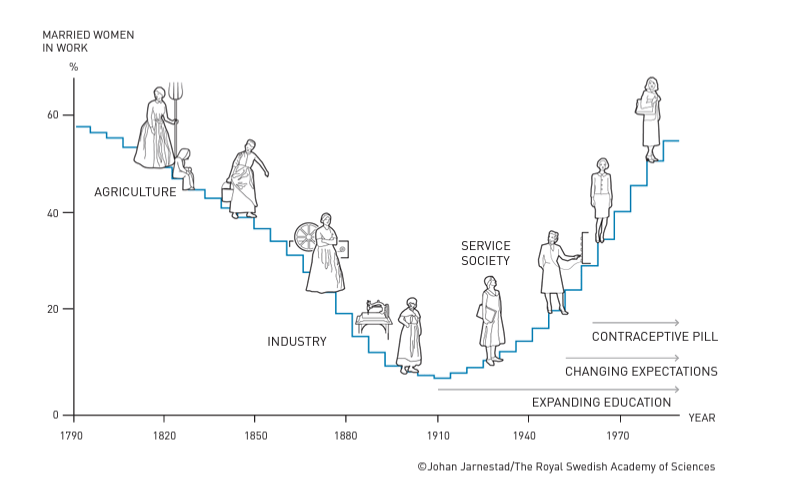
Source: nobelprize.org
On October 9, American economist Claudia Goldin was awarded the 2023 Nobel Prize in Economics for her research on women’s role in the labour market. The featured chart illustrates Goldin’s surprising finding that changed the researchers’ understanding of women’s participation in the economy.
Until Goldin published her book in 1990, researchers believed that the economic progress of a country meant a greater number of women in paid employment. However, this understanding was based on the data from the 20th century. Goldin studied data from the end of the 18th century and revealed that rapid economic progress through industrialisation actually reduced women’s participation in the labour market.
This is because industrialisation made it harder for many married women to combine work and family. Before industrialisation, women worked alongside their husbands on farms and family businesses. This is why the participation dips in the chart.
In her research, Goldin pointed out that contraceptive pills have given women greater autonomy over their lives. After the pills were introduced in the US in the 1950s, women could make better career choices by delaying marriage and childbirth. This and factors such as expanding education opportunities and a change in perception of women’s role in society have led to a greater participation of women in the economy.
Bonus Section
Can you learn to be more creative?

In 1940, James Webb Young, a popular American advertising executive, published a book called A Technique for Producing Ideas. In the book, he argued that the production of ideas is a process, just like the production of cars. The methodology he laid out in the book is effective to this day and frequently finds mention in creative thinking courses and ideation sessions.
Step 1: Gather raw materials
An idea is a combination of old elements. It blends, develops, and bounces off other ideas. If you’re working on any topic or product, you can gather two kinds of material: specific and general. Write down the specific information on index cards as you research the topic. Use a scrapbook for general material. This way, you wouldn’t worry about the structure, format and organisation.
Step 2: Digest the material mentally
Go through the material you’ve gathered. Look at it from different angles. Connect the dots. Work out a relationship between different ideas.
Step 3: Incubate
Young suggests that at one point, you should drop the whole subject from your mind and turn it over to your unconscious mind. This step is not actionable in nature. However, it gives your mind time to internalise the material you’ve gathered.
Step 4: Your mind’s response
This step in Young’s methodology slightly contrasts his idea of equating the production of ideas with that of cars. Each part of the process can be regulated when you're producing a car. But that doesn’t hold true for your brain.
Young says that by following the previous three steps carefully, you’ll experience a flash of insight. The idea you’re looking for will pop into your head when you least expect it–while taking a bath or commuting to work.
Step 5: Share your idea
In the final step, Young asks you to put your idea to work by sharing it with others. It’s necessary to receive feedback and criticism. It’ll help you refine your idea.
Liked the Bonus Section? Fill out this form and join the waitlist for our new newsletter!
Want to know more about Hamas, the terrorist organisation behind the attack on Israel? Check out my latest video:
NOTEWORTHY 📑
How did the Israel-Palestine conflict actually start?
zPod: India’s first self-driving car.
How governments around the world are trying to regulate AI.
This Indian entrepreneur is trying to produce carbon-negative bricks.
The magical and sacred cloth of Ikat.
SHARE THIS VICHAAR 🙌

If you enjoyed reading my newsletter, please consider sharing it with your loved ones.
Was this forwarded to you? Sign up here.
If you want to give us feedback, Click here.
Read our previous newsletters here
Reply