- Soch Vichaar
- Posts
- Do politicians need to be educated?
Do politicians need to be educated?

Mohak Mangal
August 22nd, 2023
What happened?
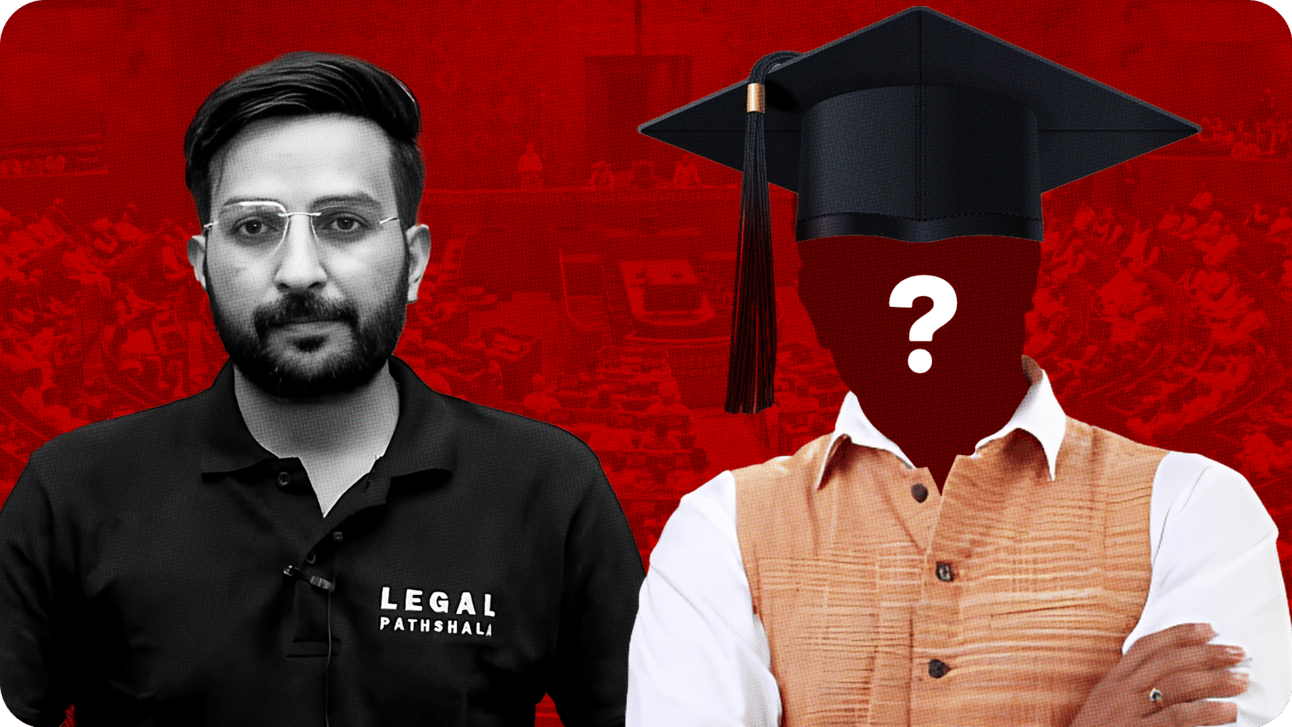
Last week, Unacademy fired a teacher who, during an online class, appealed to the students to vote for educated candidates. The ed-tech company justified that the teacher, Karan Sangwan, had violated his contract by sharing his personal opinions and views.
Why does it matter?
In the viral video, Sangwan could be heard telling his students to ‘elect educated leaders who understand things and don’t just change names’. He was apparently discussing the recent bill tabled in the Lok Sabha by Home Minister Amit Shah that seeks to replace British-era laws (read our coverage of the bills here). That’s why many allege that Sangwan was fired due to political pressure.
Whether teachers should be allowed to discuss their personal opinions in class or not is a separate debate, but his view raised an important point of discussion on the educational qualification of political candidates. The Constitution of India lays down certain eligibility criteria for MPs and MLAs, but educational qualification doesn’t find any mention. Do we need reforms?
What are the arguments from both sides?
Side 1: Education qualification must be a criterion:
Decision making: Education enhances a person’s decision-making abilities by providing them with knowledge and sharpening their critical thinking skills. An educated policymaker can better evaluate situations, arguments, and complex information. Therefore, they can make better decisions for the public good.
Development: We live in an age where the world is witnessing rapid technological growth. Educated policymakers will be better equipped to grasp the new technology and use them for the economic development of our nation. There’s empirical evidence that shows a correlation between a political leader's educational qualification and the region's economic growth during the leader's tenure in office.
Need for Reform: The reason why the criterion of education wasn’t included in the constitution is that when it was formed, illiteracy was rampant in India. And the constitution makers believed that such criteria would mean excluding most of the population from contesting elections. Now that the literacy rate has risen in India (by three folds), we need to reform the criteria.
Side 2: Education qualification must NOT be a criterion:
Wisdom: A good policymaker isn’t required to be a highly-educated person. They need remarkable knowledge of society and the aspirations of the people they represent. Most uneducated policy-makers have practical wisdom, and they’re greatly connected with the people. Therefore, if education becomes a mandatory criterion, such qualified people wouldn’t be able to participate in politics.
Advisors: There are advisory committees in diverse fields that help the government make better decisions. The experts on the committee bridge the gap in knowledge and analytical skills and offer valuable insights to the policy-makers. Well-educated bureaucrats also provide their advice to policymakers. They’re actually the ones who translate the government’s policies into actionable plans and strategies.
Elitism: Though the literacy rate has increased in the past seven decades, India remains a very unequal place. Not everybody has access to the same resources for education. If the criterion is applied, historically backward castes and the poor class would be excluded from participating in politics. This would violate the very spirit of democracy.
What’s next?
Karan Sangwan, the ex-Uncademcy teacher, has clarified that his remarks weren’t targeted at any specific government or political party.
Due to the lack of focused debate on the criterion of education qualification in the public sphere, it’s hard to say when the topic would be discussed in parliament.
Dose of Positivity
SC moves to combat gender stereotypes.

Last week, the Supreme Court released a handbook to remove gender stereotypes from the legal language. It would guide judges and the legal community to avoid using inappropriate gender terms.
For instance, the term ‘sex worker’ replaces the earlier used words such as ‘prostitute’ and ‘hooker’. Similarly, ‘spinster’ is replaced by ‘unmarried woman’; ‘housewife’ is replaced by ‘homemaker’; ‘faithful or dutiful wife’ is replaced by simply ‘wife’.
Language is an integral part of any culture. It shapes our perception and behaviour. Though the Indian judiciary is one of the most progressive institutions in India, sometimes, the lower courts end up promoting stereotypes in their language usage. It could be about the notions of live-in relationships or interfaith unions, sexual crimes against women or homosexuality. These biases then pass on to the police and lead to unfair treatment. By removing harmful terms from the legal language, the SC has set a change process in motion.
Bonus section
A Lesson from Atomic Habit

James Clear’s Atomic Habit is one of the finest guides to understanding how small changes in our daily habits can lead to significant life improvements.
Here’s one point that James stresses in his book: Designing a system around you that enables you to build good habits.
For example, if your goal is to increase your water intake. Maybe puy a water bottle next to your study/work table to remind you to drink water. If you want to remember to have your medicines, maybe put them next to your toothbrush so that you remember to take them after you brush. If you want to reduce your social media usage, consider deleting the apps from your phone. So that if you want to use Instagram or YouTube, you can only do it from your laptop.
As James puts it: focus on getting 1% better every day.
Liked the Bonus Section? Fill out this form and join the waitlist for our new newsletter!
NOTEWORTHY 📑
Chandrayaan-3’s Vikram lander to land on the moon today.
How this father is taking on patriarchy to combat female foeticide and promote gender equality.
Will we ever have a male contraceptive pill?
Check out the history of Hyderabad’s famous Karachi Bakery.
Can we build smart and sustainable cities in the future?
SHARE THIS VICHAAR 🙌

If you enjoyed reading my newsletter, please consider sharing it with your loved ones.
Was this forwarded to you? Sign up here.
If you want to give us feedback, Click here.
Read our previous newsletters here
Reply